The violence continues, and Israeli reservists are being put into Gaza now.
This sort of war, known as asymmetrical warfare, is based upon two factors: warfighting capacity and collective will.
It is called asymmetrical because the warfighting capacity of Israel is certainly superior to that of Hamas, in terms of budget, training, equipment, and doctrine.
The question of Hamas breaking the Israeli offensive by direct confrontation is not in question. This war will turn instead upon collective will. Often referred to as “national will.” Yet in the case of intrastate fighting, or subnational organizations, we must use a different term than “nation” to be technically correct. The Western Courier published a good overview of this term for the layman in early 2008: “Without National Will, Wars are Doomed.”
In this war, Israel has been very clear what they wish: for rocket attacks to cease. Hamas has been clear: they want the border to be opened. Yet Israel says the border will remain closed so long as rocket fire and suicide attacks occur.
This would seem to make it clear that to achieve their short-term goals, both sides should achieve peace reasonably swiftly.
Yet Hamas and Israel are playing a game of double-dog-dare-you on the bloodiest level, looking more towards long-term goals than short-term life-saving.
Hamas, by continually firing rockets, is daring Israel to press on in the attack. They have chosen to take the punch, and show they are still “strong,” not in terms of warfighting capacity, but in terms of national will. They are trying to test whether Israel can keep this up, or whether they’ll get bored, tired of the costs, and go home. If Israel does that, Hamas can declare “victory,” no matter what price the people have paid. Their goals are to suffer casualties and damage, and to then parley this for international sympathy.
This sort of strategy is trading Palestinian lives and Palestinian prosperity by getting Israel to commit too much economic, political and diplomatic resources for this to be “worth it.”
Israel, on the other hand, are not fighting this as a traditional asymmetrical warfare situation. This is not a “police operation.” This is an urban counterinsurgency at its most virulent. They are going into Gaza the same way that a conventional army might in a full-scale war. That there are civilian casualties is being publicly regretted, yet there seems to be an implicit lack of care for civilians so long as the military conflict is active. The conundrum to all the Israeli warnings is that, for many, there is no place to go. And, it is reported one or more of the places those fleeing the fighting went to take refuge in were bombed.
Cry “Uncle!”
The objective of this conflict therefore is not solely to destroy war-fighting capacity, but to break the will of the opponent’s political regime. To get the other guy “to cry ‘Uncle!’ first.”
We’ll have to see which side decides to bow to political pressure. The international pressure matters less to these groups than their own internal public opinion. This conflict is to prove something to domestic audiences. Though, of course, they will do so by making this situation as prominent as possible on the world stage.
Sunday, January 11, 2009

Comparative Concern
A new report on global incidence of cancer by the International Agency for Research on Cancer (IARC) was released in December 2008. With all the news of Wall Street malfeasance, it really didn’t get many headlines. Fortunately WebMD covered the story.
Every year, 12 million people are diagnosed with cancer. Globally, 8 million died of cancer in 2007. Out of a population of 6.7 billion, that is approximately a 0.12% death rate annually.
With the rise of smoking in the developing world over the past decades, long-term induced illnesses such as cancer will begin to impact an increasingly aging population. Combine this with the sustained incidences of HIV/AIDS (which worsens cancer survival rates). By 2030, the crisis will result in a projected 27 million cancer cases annually, and 17 million deaths.
In other words, over the next two decades, cancer will double in scale as a global problem.
The global population will be an estimated 8.1 billion by 2030. Thus annual cancer death rates would equate to 0.21% of the world population.
Even at present rates of mortality, over six years there would be approximately 50 million deaths and overall 72 million diagnosed cases of cancer. That casualty rate would exceed World War I death tolls, and come close to equaling the casualties suffered by World War II.
By 2030, it would be the equivalent of having a perpetual Second World War being waged on humankind. A holocaust of healthcare.
Yet, like the lobster getting used to boiling in a pot, we fail to act with due regard for cancer.
The fact is that we can, and do, affect cancer onset probabilities and cancer survival rates through research, medicine, education, environmental factors and lifestyle changes (primarily smoking and obesity). These are all elements in our society’s control. Though, perhaps, were we more united and focused, we might be able to do even better.
Meanwhile, not to ever minimize the death of a single human, other crises grab the headlines and cause us to focus our attention towards events which we cannot control or effectively alter.
Rates of Death
The following comparison may outrage some—for indeed, there is a difference between violence perpetrated upon humans, and the ravages of a disease that is outside of direct human control—yet consider the mortality to cancer versus the mortality of the present Gaza crisis.
In 15 days, 800 people have died. Annualized as a death rate, that would be a casualty figure of 19,466. This mortality rate is concentrated in the Palestinian population of 1.48 million residing in the Gaza Strip. Were that same casualty rate inflicted upon the entire world at that pace (a ratio of 800 deaths : 1.48 million population over 15 days, compared to 6.7 billion global population over 1 year), the number of deaths globally would be, approximately 88 million people in one year.
In other words, at the present rate of death, the Israeli offensive against Gaza Strip, were it applied on a global basis, would wipe out more people in one year than World War II slaughtered over six years (1939-1945 inclusive).
In absolute terms, the Gaza Crisis cannot equate to the crisis of cancer. Even if the Israelis kept up the offensive for a full year, barring a humanitarian catastrophe caused by a food, water or disease crisis, the number of casualties inflicted would be in the tens of thousands. Even at its worst and maximal extents, the Israelis could “only” exterminate 1.48 million Palestinians.
More people die of that from cancer by many times annually.
The issue is the conscious control and choices that humans make, versus the mindless ravage of disease.
What is Your Choice?
Which issue do you feel is easier to solve? Cancer on a global basis, or Middle East peace? What barriers do you believe we need to overcome to marshal global determination to defeat cancer? What barriers do you believe we need to overcome Palestinian-Israeli violence?
Which of these issues would you address first? How? What do you expect our governments to do to address these crises? What about our businesses? Our social institutions and faiths?
What strategies should we employ right now, starting today, and what strategies do we need to develop to keep these problems in check over the years ahead?
Let us know what you think!
-Peter Corless.
Global Understanding Institute
petercorless@mac.com
Every year, 12 million people are diagnosed with cancer. Globally, 8 million died of cancer in 2007. Out of a population of 6.7 billion, that is approximately a 0.12% death rate annually.
With the rise of smoking in the developing world over the past decades, long-term induced illnesses such as cancer will begin to impact an increasingly aging population. Combine this with the sustained incidences of HIV/AIDS (which worsens cancer survival rates). By 2030, the crisis will result in a projected 27 million cancer cases annually, and 17 million deaths.
In other words, over the next two decades, cancer will double in scale as a global problem.
The global population will be an estimated 8.1 billion by 2030. Thus annual cancer death rates would equate to 0.21% of the world population.
Even at present rates of mortality, over six years there would be approximately 50 million deaths and overall 72 million diagnosed cases of cancer. That casualty rate would exceed World War I death tolls, and come close to equaling the casualties suffered by World War II.
By 2030, it would be the equivalent of having a perpetual Second World War being waged on humankind. A holocaust of healthcare.
Yet, like the lobster getting used to boiling in a pot, we fail to act with due regard for cancer.
The fact is that we can, and do, affect cancer onset probabilities and cancer survival rates through research, medicine, education, environmental factors and lifestyle changes (primarily smoking and obesity). These are all elements in our society’s control. Though, perhaps, were we more united and focused, we might be able to do even better.
Meanwhile, not to ever minimize the death of a single human, other crises grab the headlines and cause us to focus our attention towards events which we cannot control or effectively alter.
Rates of Death
The following comparison may outrage some—for indeed, there is a difference between violence perpetrated upon humans, and the ravages of a disease that is outside of direct human control—yet consider the mortality to cancer versus the mortality of the present Gaza crisis.
In 15 days, 800 people have died. Annualized as a death rate, that would be a casualty figure of 19,466. This mortality rate is concentrated in the Palestinian population of 1.48 million residing in the Gaza Strip. Were that same casualty rate inflicted upon the entire world at that pace (a ratio of 800 deaths : 1.48 million population over 15 days, compared to 6.7 billion global population over 1 year), the number of deaths globally would be, approximately 88 million people in one year.
In other words, at the present rate of death, the Israeli offensive against Gaza Strip, were it applied on a global basis, would wipe out more people in one year than World War II slaughtered over six years (1939-1945 inclusive).
In absolute terms, the Gaza Crisis cannot equate to the crisis of cancer. Even if the Israelis kept up the offensive for a full year, barring a humanitarian catastrophe caused by a food, water or disease crisis, the number of casualties inflicted would be in the tens of thousands. Even at its worst and maximal extents, the Israelis could “only” exterminate 1.48 million Palestinians.
More people die of that from cancer by many times annually.
The issue is the conscious control and choices that humans make, versus the mindless ravage of disease.
What is Your Choice?
Which issue do you feel is easier to solve? Cancer on a global basis, or Middle East peace? What barriers do you believe we need to overcome to marshal global determination to defeat cancer? What barriers do you believe we need to overcome Palestinian-Israeli violence?
Which of these issues would you address first? How? What do you expect our governments to do to address these crises? What about our businesses? Our social institutions and faiths?
What strategies should we employ right now, starting today, and what strategies do we need to develop to keep these problems in check over the years ahead?
Let us know what you think!
-Peter Corless.
Global Understanding Institute
petercorless@mac.com
Saturday, January 10, 2009
International Linguistics
Earlier this month Franklin Pham contacted me from Paris. Prior to that, I had a chat with Carlos Suarez here in Mountain View.
The conversation considered the internationalization of Global Understanding (GU). This is an English-language version of the organization name. Yet how would the organization be known when translated into foreign languages?
Rendered into Spanish, it will be known as Entiende Global (EG). And in French, Entente Globale (EG).
Entiende or Entente mean “to make sense” of something. It is a word choice which can be compared to the Spanish “Comprensión,” or French “Arrangement.” The former is more focused on the internal subjective integration of knowledge, and the latter on a mutual settlement or agreement. Instead, “to make sense,” while a subjective interpretation, is still outward focused. To sense requires observation and bring internal information regarding the world around us. Yet “entente” is a feminine noun, which, besides meaning “understanding” and “agreement,” also means “harmony.”
What other ways can we translate the term Global Understanding? Please add your suggestions in the comments.
-Peter Corless.
The conversation considered the internationalization of Global Understanding (GU). This is an English-language version of the organization name. Yet how would the organization be known when translated into foreign languages?
Rendered into Spanish, it will be known as Entiende Global (EG). And in French, Entente Globale (EG).
Entiende or Entente mean “to make sense” of something. It is a word choice which can be compared to the Spanish “Comprensión,” or French “Arrangement.” The former is more focused on the internal subjective integration of knowledge, and the latter on a mutual settlement or agreement. Instead, “to make sense,” while a subjective interpretation, is still outward focused. To sense requires observation and bring internal information regarding the world around us. Yet “entente” is a feminine noun, which, besides meaning “understanding” and “agreement,” also means “harmony.”
What other ways can we translate the term Global Understanding? Please add your suggestions in the comments.
-Peter Corless.
Thursday, January 8, 2009
Freedom House - New Report Due January 12
Get ready for new a new report by Freedom House about the state of political Freedom in the World.
What color do you believe the United States (or your own nation, if you are overseas) should get? Green (free), Yellow (partly free), or Blue (Not free).
How would you rate the U.S. (or your own country) on a scale of 1 (most free) to 7 (least free). In 2008, it scored a 1 in political rights and 1 in civil liberties. Have we done better, worse, or stayed the same since last year?
Freedom is not a guarantee problems will not still form. According to the 2008 report by Freedom House, "The United States was ranked 20 out of 180 countries surveyed in Transparency International’s 2007 Corruption Perceptions Index."
As Bernard Madoff shows, we're not "the best" in terms of avoiding corruption.
Stay tuned for the January 12th release of the new 2009 report!
What color do you believe the United States (or your own nation, if you are overseas) should get? Green (free), Yellow (partly free), or Blue (Not free).
How would you rate the U.S. (or your own country) on a scale of 1 (most free) to 7 (least free). In 2008, it scored a 1 in political rights and 1 in civil liberties. Have we done better, worse, or stayed the same since last year?
Freedom is not a guarantee problems will not still form. According to the 2008 report by Freedom House, "The United States was ranked 20 out of 180 countries surveyed in Transparency International’s 2007 Corruption Perceptions Index."
As Bernard Madoff shows, we're not "the best" in terms of avoiding corruption.
Stay tuned for the January 12th release of the new 2009 report!
Wednesday, January 7, 2009
Somalia: Assassination of those working for reconciliation
Radio Shabelle, and the Shabelle Media Network, provide Somalia, and the international Somali diaspora, with news about what is going on in the nation. However, the government often accuses it of being partial to the Islamist movement Al-Shabaab, the insurgent military successor of the prior Islamic Courts Union (ICU) government of 2005-2007. This was the reason given by the soldiers who shot to death Hassan Mayow Hassan. His widow and children were just given $3000 aid from the Doha Centre for Media Freedom, facilitated by the National Union of Somali Journalists (NUSOJ). There is great concern over the death and kidnapping of journalists. Ten have been murdered over the past two years. Shabelle published a timeline of just the past year’s incidents as an example. Recently Colin Freeman and Jose Cendon were freed. Others remain targeted or held in captivity.
News also reported the gunning down of Ismail Hassan Timir, Deputy Minister for Reconciliation in December, and Abdullahi Abdi Egaal, a member of the National Reconciliation Commission, this month.
On top of that, World Food Programme workers continue to be assassinated. All they are trying to do is to feed children. What motive drives people to commit the death of aid workers?
These blows are aimed at those working for clarity and a middle ground in the midst of the chaos.
American Strategy for the Horn
The only mention of the United States in the region is as a contributor to the international naval anti-piracy mission, and in conducting logistical, intelligence and covert operations support to Somalia and Ethiopia, striking at Al-Shebaab when and where there is clear intelligence its operatives had ties to al Qaeda. So far the U.S. has made five known strikes.
• BBC Report: US fails to break Somalia extremists (1 January 2009)
Ethiopia, mired after its 2006 invasion, is planning on withdrawing its troops from Somalia. Abdullahi Yusuf, who the international community hoped would lead the Transitional National Government into the first nationally-recognized government since Siad Barre, quit the Presidency at the end of 2008.
The nation seems once again freefalling towards warlordism, piracy and militant extremism. Yet also, it is possible the President’s departure, as well as some of the slayings, may lead to a compromise with Islamic opposition government supporters. Yusuf’s tenure was often a highly-contentious one with the parliament. He failed to have Mohamed Mahamud Guled, his own choice for Prime Minister appointed recently. A moderate group of Islamists, Ahlu Sunna Waljamaca, has reportedly sprung up to fight the militants of Al-Shabaab.
It will be very interesting to see how U.S. policy shifts in the Horn of Africa with the new Obama administration.
News also reported the gunning down of Ismail Hassan Timir, Deputy Minister for Reconciliation in December, and Abdullahi Abdi Egaal, a member of the National Reconciliation Commission, this month.
On top of that, World Food Programme workers continue to be assassinated. All they are trying to do is to feed children. What motive drives people to commit the death of aid workers?
These blows are aimed at those working for clarity and a middle ground in the midst of the chaos.
American Strategy for the Horn
The only mention of the United States in the region is as a contributor to the international naval anti-piracy mission, and in conducting logistical, intelligence and covert operations support to Somalia and Ethiopia, striking at Al-Shebaab when and where there is clear intelligence its operatives had ties to al Qaeda. So far the U.S. has made five known strikes.
• BBC Report: US fails to break Somalia extremists (1 January 2009)
Ethiopia, mired after its 2006 invasion, is planning on withdrawing its troops from Somalia. Abdullahi Yusuf, who the international community hoped would lead the Transitional National Government into the first nationally-recognized government since Siad Barre, quit the Presidency at the end of 2008.
The nation seems once again freefalling towards warlordism, piracy and militant extremism. Yet also, it is possible the President’s departure, as well as some of the slayings, may lead to a compromise with Islamic opposition government supporters. Yusuf’s tenure was often a highly-contentious one with the parliament. He failed to have Mohamed Mahamud Guled, his own choice for Prime Minister appointed recently. A moderate group of Islamists, Ahlu Sunna Waljamaca, has reportedly sprung up to fight the militants of Al-Shabaab.
It will be very interesting to see how U.S. policy shifts in the Horn of Africa with the new Obama administration.
Budget Deficit to hit $1.2 trillion. Are we stupid?
Mr. Dirksen, we salute you!
To modernize Everett Dirksen’s economic observation, “A trillion here, a trillion there, and pretty soon, you are talking real money.” Remember, however, that he was talking about “a million” here and there.
Some people have little idea how to actually picture a trillion dollars. It’s a million millions. So imagine a city of a million millionaires. While that sounds like a dream, consider that reality has a price associated with it. Someone, or a lot of someones, actually, had to empty the pennies of their pocket to make someone else a millionaire.
Remember the old monetary axiom: “easy come, easy go?” Right now, a lot of the millionaires that made an easy million have already lost it. That easy money is drying up faster than water in the desert. And with it is also going a lot of the hard-earned cash too.
Hard Numbers
The U.S. government will have a shortfall of $1.186 trillion dollars in the 2009 fiscal year. Fiscal year 2010, which begins in October 2009, will also have a shortfall, of an estimated $703 billion.
However, this lower figure does not take into consideration emergency funding for natural or economic disasters, or unplanned security and defense spending due to international events.
The U.S. government’s debt at the beginning of the Bush administration was $5.7 trillion. It will now stand at $10.6 trillion.
By the numbers above, it is clearly rising towards $12 trillion.
That stands in stark comparison to the estimated U.S. Gross Domestic Product of $14.334 trillion, and a Federal budget receipts (income) of $2.66 trillion.
A More Personal Weight of Debt
If the U.S. federal government’s budget revenues of $2.66 trillion were shrunk down to the typical U.S. household median income of $50,233, the current debt load would be felt like having a $200,000 loan hanging over you. The problem is actually only about half that bad in reality (which I will show later), but that’s how it would feel.
However, rather than paying down your loan every year, you got more debts. The U.S. deficit of $1.186 trillion, if that were reduced to a personal finance level, would be like paying off nothing but interest payments, and then taking on another $22,400 debt on top of what you already owe. And then next year, planning on taking on another $13,275.
The October 2008 per capita debt estimate (for every infant born, every child, every young adult, every adult and every senior) was $31,700 (Source: Wikipedia). That’s bad enough. Yet by FY2010, the U.S. federal budget will be $12.489 trillion in debt. Distributed amongst the projected population of 308.9 million in that year, that would be a per capita debt load of $40,425.
Distributed amongst the roughly 116 million households of the United States, the average household debt burden of the United States government in 2010 will be about $107,000.
In other words, to afford to pay off the U.S. government debt at the present time would require, from every household in the nation, the equivalent of selling off your home or taking out a small mortgage.
How Much Money Do We Got?
Another way to look at this issue of debt in terms of scale is that the money supply. If a waiter brings you a bill, you look at the money you have in your wallet. How much is in it?
The M2, which combines all cash, checking, savings accounts, CDs up to $100k, and money market accounts, only totals around $7 trillion. That is the rough amount of money in the hands of citizens around the nation.
Once the amount of currency you have to redeem in an economy is less than the amount that you theoretically owe, you are in trouble.
A key issue of ecomonic policy not being addressed is: where is the money these days, and who is holding onto it?
For instance, the M2 is not entirely complete. There is more money. In the M3, which measures a broader index. Plus in the stock and commodities markets. Yet this broadens the definition of who bears the burden of our national economy to include institutions and businesses.
Yet the Federal Reserve ceased tracking the M3 during the Bush administration. Tracking of this broader index, which measured more institutional money supplies, as well as eurodollars and repurchase agreements, was halted in 2006. This index measured the accounts used to meet monetary demands of the economy. The Federal Reserve cited the cost to gather the information, and that the data was not very useful.
Though this was often left for policy wonks, arguments against increase of the M3 as a percentage of the economy, and concern over the tracking of the M3 built up over time. Stopping the monitoring of the M3 alarmed many. Because the M3 focused on visibility of the total, actual money supply. An example of the early alarms include Guy M. Lerner’s 2004 article, ”M3 Money Supply: Support of a Different Kind.” For an example of the more recent criticism of the lack of tracking of the M3, see Jerry Mazza’s 2008 article, “Follow the M3 to hell.”
Once these institutional investments were not tracked, the total money supply could not be really understood. If the M3 can be increased without being monitored, it could depreciate the money supply without oversight.
Since the Federal Reserve Board ceased tracking M3, private organizations have attempted to maintain a watchful eye on the M3. ShadowStats.com shows the bubble of growth in M3 during 2007-2008 after the Fed took their eye off the index:

As you can see, physical currency (cash) is rising incredibly fast in the latter half of 2008 (what is known as M0), while the spike in M3 is slowing. Note that the M3 is stil growing. Just not as fast. And it peaked in growth 2007-2008, no sooner than the Fed took its official eye off the ball.
The housing bubble, combined with the oil price shock, definitely took the wind out of the sails of the economy.
Ride the Wave from Micro to Macro Scale
Just as the world seems to wash over us individually, there are theories that these situations, on a macroeconomic scale, follow their own patterns of behavior. These long-term economic, social, technological and political cycles are called Kondratiev waves. Study of such waves, if they exist, and if scientifically analyzed, would fall under systems theory, game theory, and cybernetics.
One of the truths of scientific observation is that when something is studied, it changes behavior. Even if it is not aware of being studied, the fact that it is being observed changes the operations of the universe. Things that could have gone unnoticed now are salient to the senses of the observer. The very fact that there is an attention being paid to the subject changes the subject. The subject might not know or care. Or perceptibly know or care. According to other theories, including some more spiritual than scientific, the fact that you are watching a subject, or that some divine entity is watching, alters the outcome of the universe.
Yet if a system is aware, or becomes aware, it is being studied, it behaves quite differently. This is fundamental to cybernetics, which requires a system to have cognizance of feedback to its environment, as well as its own behavior or performance. Don’t you act differently when you know someone is staring at you? Don’t you act differently when you know no one is watching? Well, the world, and the human populace thereof, act the same way. It, and we, become more self-conscious when studied. We can ignore our own behavior when left to our own devices. Yet when someone else watches us, generally we act on that truth. Our own internal feedback is amplified when someone else is present. Or at least, it should be.
Stupidity Theory Meets The World!
One of my favorite theories to arise in recent years is stupidity theory. James F. Welles generic black-and-white little book, Understanding Stupidity, was released a few decades ago, in 1986. You can read the book online these days. Yet while it is book-length, the basic premise and summation of the book is simple:
(Author’s emphasis maintained.)
Welles does not maintain that all behaviors that lead to failure exhibited by humans as stupid, “just those which betray a compromise commitment to perceptual accuracy and social integrity by going to an unnecessary extreme.”
In terms of our economy, the frenetic drive the U.S. and other nations around the world exhibit simply to maintain the perception that our economy is growing, healthy, and stable would be the fundamental root of our stupidity. For the longer we maintained the illusions of a prosperous economy, all-the-while fueled on a ballooning federal and personal debt load, the more painful the eventual acknowledgment of the reality of our situation.
The cure for stupidity is to admit the truth, face failures, to step back from the worst of our failures, and to establish plans for a new, more sustainable and healthy future.
We are in an unprecedented level of public and personal debt on a global basis. There is no model that mirrors what state we are in, for never before have there been 6.7 billion people on the planet owing this level of money to each other in a complex system of credits and obligations. We cannot go back, in the U.S., to our Founding Fathers, because they did not face the same problems we face. While we can look to the past for inspiration and for prudence in times of crises, in the 21st Century, we must chart our own future, and posit a method to maintain a sustainable national and world economy.
The height of stupidity is to not change behavior, even when people are studying you. Staring at you. Asking you questions. Telling you that this behavior is in your own worst interest.
We must, as a society, ask ourselves if we are being collectively stupid. An increasing number of us cannot afford education. Healthcare. Housing. Yet the entertainment and luxury goods markets of our nation continue to expand their offerings, to the distraction of fundamental elements of life-and-death, personal nourishment and the global environment, social ethics, and economic solvency. If so, what can we do to smarten up?
How can we “live lean” in the next few years to bring down our ballooning debt? Or how can we “earn more” or “value better” what we do so that we feel adequately recognized and are not squabbling over diminishing pie crumbs?
We will either face this with creative solutions, or reap the whirlwind. Or, as usual, muddle through as a collective species doing quite a bit of both.
To modernize Everett Dirksen’s economic observation, “A trillion here, a trillion there, and pretty soon, you are talking real money.” Remember, however, that he was talking about “a million” here and there.
Some people have little idea how to actually picture a trillion dollars. It’s a million millions. So imagine a city of a million millionaires. While that sounds like a dream, consider that reality has a price associated with it. Someone, or a lot of someones, actually, had to empty the pennies of their pocket to make someone else a millionaire.
Remember the old monetary axiom: “easy come, easy go?” Right now, a lot of the millionaires that made an easy million have already lost it. That easy money is drying up faster than water in the desert. And with it is also going a lot of the hard-earned cash too.
Hard Numbers
The U.S. government will have a shortfall of $1.186 trillion dollars in the 2009 fiscal year. Fiscal year 2010, which begins in October 2009, will also have a shortfall, of an estimated $703 billion.
However, this lower figure does not take into consideration emergency funding for natural or economic disasters, or unplanned security and defense spending due to international events.
The U.S. government’s debt at the beginning of the Bush administration was $5.7 trillion. It will now stand at $10.6 trillion.
By the numbers above, it is clearly rising towards $12 trillion.
That stands in stark comparison to the estimated U.S. Gross Domestic Product of $14.334 trillion, and a Federal budget receipts (income) of $2.66 trillion.
A More Personal Weight of Debt
If the U.S. federal government’s budget revenues of $2.66 trillion were shrunk down to the typical U.S. household median income of $50,233, the current debt load would be felt like having a $200,000 loan hanging over you. The problem is actually only about half that bad in reality (which I will show later), but that’s how it would feel.
However, rather than paying down your loan every year, you got more debts. The U.S. deficit of $1.186 trillion, if that were reduced to a personal finance level, would be like paying off nothing but interest payments, and then taking on another $22,400 debt on top of what you already owe. And then next year, planning on taking on another $13,275.
The October 2008 per capita debt estimate (for every infant born, every child, every young adult, every adult and every senior) was $31,700 (Source: Wikipedia). That’s bad enough. Yet by FY2010, the U.S. federal budget will be $12.489 trillion in debt. Distributed amongst the projected population of 308.9 million in that year, that would be a per capita debt load of $40,425.
Distributed amongst the roughly 116 million households of the United States, the average household debt burden of the United States government in 2010 will be about $107,000.
In other words, to afford to pay off the U.S. government debt at the present time would require, from every household in the nation, the equivalent of selling off your home or taking out a small mortgage.
How Much Money Do We Got?
Another way to look at this issue of debt in terms of scale is that the money supply. If a waiter brings you a bill, you look at the money you have in your wallet. How much is in it?
The M2, which combines all cash, checking, savings accounts, CDs up to $100k, and money market accounts, only totals around $7 trillion. That is the rough amount of money in the hands of citizens around the nation.
Once the amount of currency you have to redeem in an economy is less than the amount that you theoretically owe, you are in trouble.
A key issue of ecomonic policy not being addressed is: where is the money these days, and who is holding onto it?
For instance, the M2 is not entirely complete. There is more money. In the M3, which measures a broader index. Plus in the stock and commodities markets. Yet this broadens the definition of who bears the burden of our national economy to include institutions and businesses.
Yet the Federal Reserve ceased tracking the M3 during the Bush administration. Tracking of this broader index, which measured more institutional money supplies, as well as eurodollars and repurchase agreements, was halted in 2006. This index measured the accounts used to meet monetary demands of the economy. The Federal Reserve cited the cost to gather the information, and that the data was not very useful.
Though this was often left for policy wonks, arguments against increase of the M3 as a percentage of the economy, and concern over the tracking of the M3 built up over time. Stopping the monitoring of the M3 alarmed many. Because the M3 focused on visibility of the total, actual money supply. An example of the early alarms include Guy M. Lerner’s 2004 article, ”M3 Money Supply: Support of a Different Kind.” For an example of the more recent criticism of the lack of tracking of the M3, see Jerry Mazza’s 2008 article, “Follow the M3 to hell.”
Once these institutional investments were not tracked, the total money supply could not be really understood. If the M3 can be increased without being monitored, it could depreciate the money supply without oversight.
Since the Federal Reserve Board ceased tracking M3, private organizations have attempted to maintain a watchful eye on the M3. ShadowStats.com shows the bubble of growth in M3 during 2007-2008 after the Fed took their eye off the index:
As you can see, physical currency (cash) is rising incredibly fast in the latter half of 2008 (what is known as M0), while the spike in M3 is slowing. Note that the M3 is stil growing. Just not as fast. And it peaked in growth 2007-2008, no sooner than the Fed took its official eye off the ball.
The housing bubble, combined with the oil price shock, definitely took the wind out of the sails of the economy.
Ride the Wave from Micro to Macro Scale
Just as the world seems to wash over us individually, there are theories that these situations, on a macroeconomic scale, follow their own patterns of behavior. These long-term economic, social, technological and political cycles are called Kondratiev waves. Study of such waves, if they exist, and if scientifically analyzed, would fall under systems theory, game theory, and cybernetics.
One of the truths of scientific observation is that when something is studied, it changes behavior. Even if it is not aware of being studied, the fact that it is being observed changes the operations of the universe. Things that could have gone unnoticed now are salient to the senses of the observer. The very fact that there is an attention being paid to the subject changes the subject. The subject might not know or care. Or perceptibly know or care. According to other theories, including some more spiritual than scientific, the fact that you are watching a subject, or that some divine entity is watching, alters the outcome of the universe.
Yet if a system is aware, or becomes aware, it is being studied, it behaves quite differently. This is fundamental to cybernetics, which requires a system to have cognizance of feedback to its environment, as well as its own behavior or performance. Don’t you act differently when you know someone is staring at you? Don’t you act differently when you know no one is watching? Well, the world, and the human populace thereof, act the same way. It, and we, become more self-conscious when studied. We can ignore our own behavior when left to our own devices. Yet when someone else watches us, generally we act on that truth. Our own internal feedback is amplified when someone else is present. Or at least, it should be.
Stupidity Theory Meets The World!
One of my favorite theories to arise in recent years is stupidity theory. James F. Welles generic black-and-white little book, Understanding Stupidity, was released a few decades ago, in 1986. You can read the book online these days. Yet while it is book-length, the basic premise and summation of the book is simple:
...within the microcosm of each particular cultural group, the self-deceptive language/perception complex, a social commitment to norms and pressure toward groupthink all can contribute via the neurotic paradox to setting up a positive feedback system which carries a given learning pattern to self-defeating excess. Contrary to prevailing Darwinian dogma, this normal learning mechanism can render human behavior maladaptive, with different groups of people and individuals commonly vying and dying to display their own particular form of the general phenomenon we call stupidity. Resultant behavior is properly termed stupid when it is justly construed as failing according to and because of the ends (purposes) and/or means (methods and morality) of the reference group.
(Author’s emphasis maintained.)
Welles does not maintain that all behaviors that lead to failure exhibited by humans as stupid, “just those which betray a compromise commitment to perceptual accuracy and social integrity by going to an unnecessary extreme.”
In terms of our economy, the frenetic drive the U.S. and other nations around the world exhibit simply to maintain the perception that our economy is growing, healthy, and stable would be the fundamental root of our stupidity. For the longer we maintained the illusions of a prosperous economy, all-the-while fueled on a ballooning federal and personal debt load, the more painful the eventual acknowledgment of the reality of our situation.
The cure for stupidity is to admit the truth, face failures, to step back from the worst of our failures, and to establish plans for a new, more sustainable and healthy future.
We are in an unprecedented level of public and personal debt on a global basis. There is no model that mirrors what state we are in, for never before have there been 6.7 billion people on the planet owing this level of money to each other in a complex system of credits and obligations. We cannot go back, in the U.S., to our Founding Fathers, because they did not face the same problems we face. While we can look to the past for inspiration and for prudence in times of crises, in the 21st Century, we must chart our own future, and posit a method to maintain a sustainable national and world economy.
The height of stupidity is to not change behavior, even when people are studying you. Staring at you. Asking you questions. Telling you that this behavior is in your own worst interest.
We must, as a society, ask ourselves if we are being collectively stupid. An increasing number of us cannot afford education. Healthcare. Housing. Yet the entertainment and luxury goods markets of our nation continue to expand their offerings, to the distraction of fundamental elements of life-and-death, personal nourishment and the global environment, social ethics, and economic solvency. If so, what can we do to smarten up?
How can we “live lean” in the next few years to bring down our ballooning debt? Or how can we “earn more” or “value better” what we do so that we feel adequately recognized and are not squabbling over diminishing pie crumbs?
We will either face this with creative solutions, or reap the whirlwind. Or, as usual, muddle through as a collective species doing quite a bit of both.
Saturday, January 3, 2009
DipNote: The U.S. State Department's Official Blog
“Question of the Week: What Means Are Available To Resume a Path Toward Israeli-Palestinian Peace?”In response, I sent this to the U.S. State Department:
These are the requirements for any peaceful settlement:
1. Recognition of each others' state's and government's right to exist.
2. A determination of whether Gaza will be independent of, or part of, the Palestinian Authority. To be determined by a referendum within Gaza and Palestine, to be certified by independent international monitors.
3. A recognition of prior agreements and concords, such as the Wye River Memorandum, Camp David 2000 Summit, Beirut Summit, etc.
4. A significant return to negotiations regarding the 2003 "Road Map" for peace.
5. Financial Stimulus for both parties for peace. Tie international aid and investment to peace and accord. While permitting certain forms of humanitarian and basic economic support (food, fuel, etc.), have the US, EU, and other top 20 economies tie more advanced forms of finance and economic development to Israel and Palestine based upon specific curtailments of violence by their own societies. If there was profit to be found in peace, more people would choose it. Terrorists, militants and pro-conflict zealots would then lose popular support by alienating the rest of the world and making their own people suffer. Moderates would then be incented to calm radicals and extremists in their populations. Put some billions into peace, and see who responds. Pay only a little up-front as incentives and as "seed capital" for programs. Then ramp up payments and investment as people prove they can indeed manage their own societies.
6. Work towards border openings and diplomatic relations for Gaza based on management of violence and corruption.
7. Try to elevate the Geneva Accord back to the table, and find out what specific objections there are towards it in both Palestinian and Israeli circles. Find the specific objections, and see what can be done to produce a gap-analysis compromise settlement. Phase in compliance to a permanent settlement over time based on conformance of both parties.
8. If need be, consider authorizing an international peacekeeping force of up to 10,000 to go between Israel and Gaza, and to patrol Gaza. Have it comprised of members of Islamic states to prevent issues of non-Islamic military being present. Give them the right to police the Gaza strip, including shoot-to-kill orders for people who set up rockets to kill civilians in Israel. Ensure neutral nations provide logistics, accounting, and judiciary/military police to prevent collusion and/or illicit arms shipments coming in to fuel Gaza militant groups clandestinely.
What are your thoughts?
Wednesday, December 31, 2008
Pakistan Uncovers Lashkar-e-Taiba Involvement in Mumbai Bombings
Pakistani officials disclosed that they discovered, through their own investigations, connections between Lashkar-e-Taiba (LeT) and the Mumbai attackers. This confirms what has been suspected for over a month since the November attacks.
While the revelation may not prove significant to those who had been following the crisis closely, what it may mean is that Pakistan and India may agree on the basis of the cause of the attacks, and thus may begin to thaw in terms of working towards a common resolution of the investigation and a mutual diffusion of hostilities.
Much remains to be seen regarding how far and deep the investigation will go into the LeT organization and, possibly, the Pakistani military and intelligence branches which allegedly supported their operations.
While the revelation may not prove significant to those who had been following the crisis closely, what it may mean is that Pakistan and India may agree on the basis of the cause of the attacks, and thus may begin to thaw in terms of working towards a common resolution of the investigation and a mutual diffusion of hostilities.
Much remains to be seen regarding how far and deep the investigation will go into the LeT organization and, possibly, the Pakistani military and intelligence branches which allegedly supported their operations.
Monday, December 29, 2008
"India: Let Kashmir Go" (Bennett Ramberg in Christian Science Monitor)
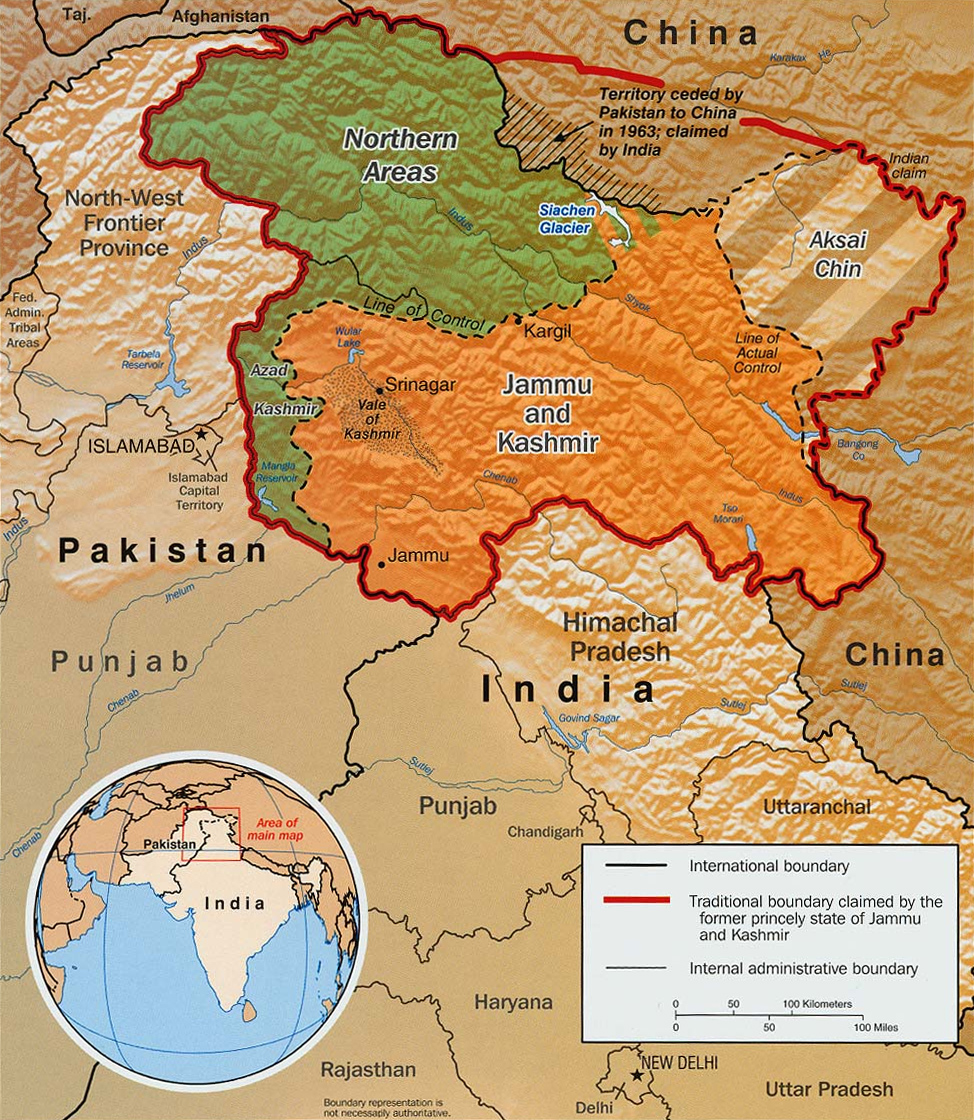 “The Disuted Territory” Shown in green is Kashmiri region under Pakistani control. The dark-brown region represents Indian-controlled Jammu and Kashmir while the Aksai Chin is under Chinese occupation. Source: Wikipedia citation of the CIA World Factbook
Bennett Ramberg, in an opinion piece for the Christian Science Monitor, suggests for India to let Kashmir go: “options include independence, division along communal lines, comanagement by both India and Pakistan, [or] a UN trusteeship.”
It is generally easy for an outside observer to discuss giving away someone else’s percieved property, rights and claims. How easy it can be for us to tell someone else, “All you need to do is give up what you’ve been struggling over for generations.” The more difficult thing to do is for each party to consider what is best for the other parties involved, as well as consider their own interests. New equilibrium outcomes can only be likely when opinions are open to new considerations. Otherwise, mentalities and opinions will likely go back to pre-existing expectations and de facto schemas.
Kashmir: A Reverse Land for Peace Deal?
“Let it go.” This simple-sounding axiom, couched by the citation by Ramberg of the amicable division of Czechoslovakia, and the mostly peaceful dissolution of the Soviet Union, is not so easily cut-and-dried. The Czech Republic and Slovakia were both swept into a ready-and-waiting strong neighborly brotherhood of the EU and NATO. There were extremely wealthy vested interests in seeing this be a friendly, happy, and amicable divorce. The same was certainly not true for nearby Yugoslavia, which, once the pins were pulled out of its national structures, turned into a decade-long tragedy.
Having India let Jammu and Kashmir go would be far more akin to the Arab-Israeli “Land for Peace” consideration. Which, like the Kashmir question, has historical roots in conflicts that broke out in the post-World War II division of lands between Muslims and non-Muslims.
Yet as Ramberg himself points out, Indian wargaming strategies show a reverse “land for peace” deal is more likely. Under the Indian “Cold Start” strategy, India would seize Pakistani border territory in a rapid strike. Then, it would put pressure on Pakistan to meet its demands for the withdrawal from Pakistani territories.
In other words, the same sorts of territorial disputes that followed the Arab-Israeli 1967 war might await the region in a future Indian-Pakistani conflict. It would be an inverse of the 1999 Kargil War, where Pakistani units infiltrated and held onto territory in Indian-controlled Kashmir. Yet that conflict pushed the prospects of nuclear war to the brink. Pakistan’s government is still extremely unstable. Such conventional warfare might result in utterly horrific casualties if violence spiralled out of proportion.
Does It Matter Who Runs Kashmir?
Yes. Apparently.
Both the Indian government and Pakistani government are infamous for corruption, negligence, self-serving deals, fratricidal political infighting, veiled (and not-so-veiled) use of violence, and, of course, crass nepotism. Pakistan is ranked as low as #134 out of 180 nations in the world in terms of corruption; India at #85, though mis-management in Jammu and Kashmir is specifically noted as extreme. It is the most-corruptly administered area of the Indian nation.
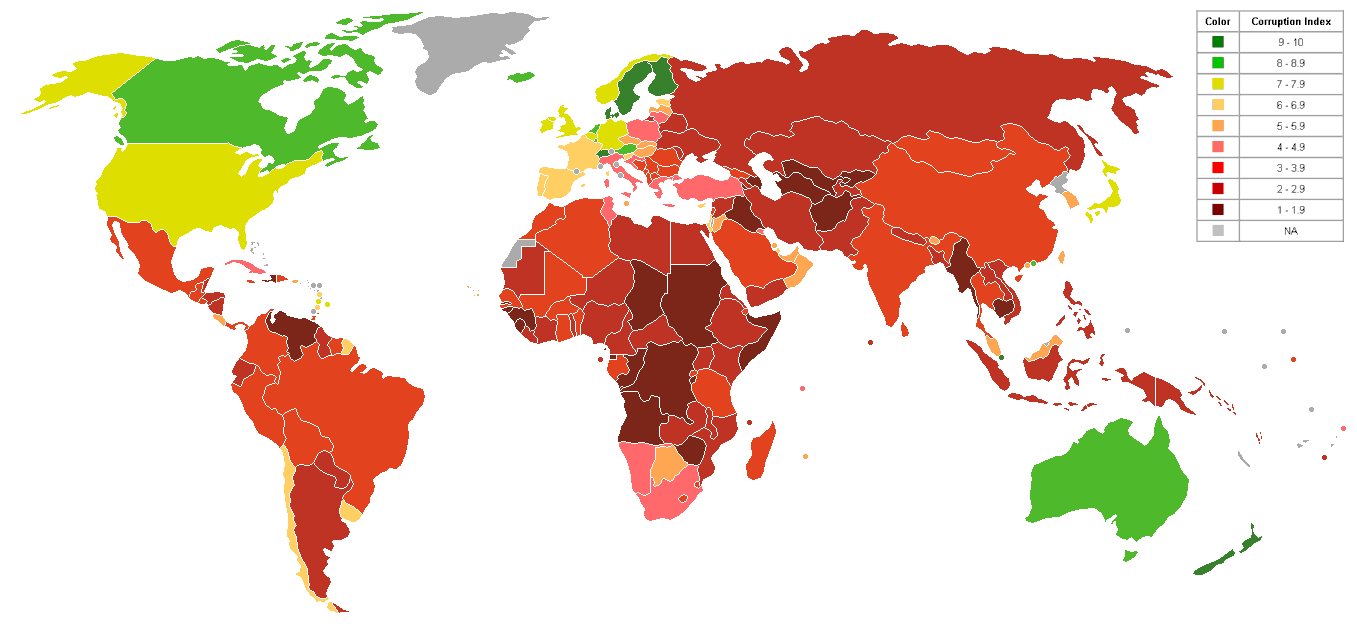
Index of perception of corruption. Source: Wikipedia, based on data from Transparency International
Mind you that the governments of India and Pakistan are seen, regionally, to be some of the less-corrupt governments in south Asia. Add to that the numerous wars fought between the two nations since 1947, and you can see the reasons for distrust.
Thus, to a great degree, much of the lack of trust boils over into not wanting the other side’s corrupt politicians getting their greedy hands on the territory. Instead, both nations feel comfortable that their own corrupt political machines can rule over Jammu and Kashmir, while the other nation’s bureaucracy is exoriated and derided.
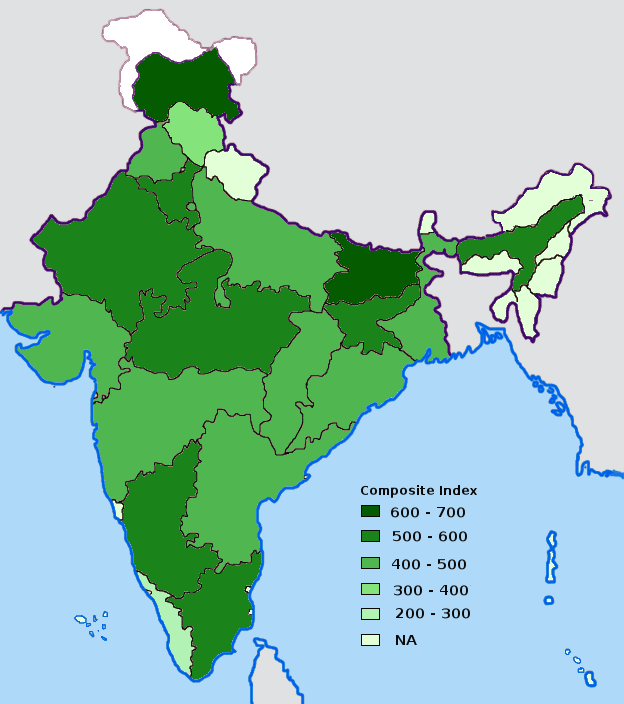 Index of Corruption in Indian states in 2005;
Note Jammu & Kashmir in the north is the most corrupt.
Source: Wikipedia
Pluralism: It Begs the Question
At its heart, there lurks the fundamental issue of pluralism: whether there can be peaceful co-existance of different religions and ethnicities in these territories. It would matter less which nation administered these territories if the rights of various populations were respected, and services guaranteed on a basis of civil equality.
So long as there is distrust, and indeed, a fair basis for the common people of the region to believe there is good reason to not trust politicians of either government, there will be the resultant undermining from below, oppression from above, forces exploding out from the middle, or a society collapsing in upon itself. There can be no stability regardless of which national government seeks to establish suzerainty over the territory. Furthermore, a region left in “free fall” will find neighbors pumping in money, leadership, and elements of control to seize power.
It should be noted that a strong external government cannot necessarily enforce a strong local result. For instance, since the United States intervention in Afghanistan and Iraq, their national institutions have floundered horrifically. Afghanistan ranks #176, and Iraq at #178 on the Transparency International Corruption Perception Index for 2008, out of 180 nations ranked. They are in the company of such basketcase nationstates as Somalia, Haiti and Sudan.
Pulling out a strong national government does not necessarily equate to peace and stability in terms of residual institutions. Since the collapse of the Soviet Union, a few former republics have fared well, yet Tajikistan (tied for #151 place), Azerbaijan (#158), Kyrgyzstan (#166), Turkmenistan (#167), and Uzbekistan (#168) have fallen precipitously and become very corrupt states.
It is no guarantee a simple pullback of India from the area would guarantee peace and stability. Much the same way that a pullout of Lebanon by Syria and Israel did not guarantee, immediately, a functional state. While Lebanon is waveringly rising from the impoverished state it was reduced to by decades of civil war, much violence and tension remains. Further, there was never a consideration of Lebanon being a province of Syria or Israel.
Instead, Kashmir might be more likened to the Palestinian territories, which were once claimed by Israel. Yet this is not precisely a model of a stable, friendly independent state along the withdrawing power’s borders. Such models bode poorly for India’s northern border were Kashmir made independent.
What Do Indians Want?
According to a Times of India article, dated 23 August 2008, 59% of Indians believe “India should hold on to Kashmir despite the economic cost of doing so.” 11% were undecided. 30% said the cost of doing so was already too high.
The most telling statistic was that 68% of Indians believed Kashmir should not be allowed to secede from India even if it wanted to. To them, alienating Jammu and Kashmir would be akin to the United States allowing one of our own fifty states to withdraw from the nation.
This survey showed that about 30% believe the cost of holding on to Kashmir is already too high. A minority opinion of about that proportion might theoretically support Kashmir’s independence from India. According to the Times of India: “At one level, it indicates that what was simply not thinkable until now - whether Kashmir could secede from the Indian Union or not - has possibly become a matter of debate, even if it is within a small section of our urban society.”
However, the same study also showed that only 19% felt such a move would make the country more secure. 31% felt it would make no difference to Indian security—threats, such as terrorism, would remain regardless of whether Kashmir went its own way or not. “As for fear, a clear half said India would become a less safe place if Kashmir were allowed to secede. In other words, the terror threat to the country would only increase if the northern border were to come closer to the country's heartland.”
Instead, the predominant opinion, held by more than 75% of those surveyed, felt Kashmir could still be integrated into the mainstream of Indian governmental organization and social structure.
Amongst these surveyed Indians, 41% felt that Kashmir had been neglected by government. 30% felt Kashmir had been treated fairly, and an almost equal number, 29%, felt it had been pampered.
Pakistani Concerns
Pakistani opinions are very fractious now, far more than India. The nation is facing a low-grade internal civil war, or at least, autonomous state withdrawal from central administration. It is possible India might need to intercede along the Pakistani border for better security if military or paramilitary organizations went rogue and decided to spill violence over the border into India.
Pakistani military involvement, though denied, has been detected in schemes using now out-of-control paramilitaries from the Kargil War to the recent Mumbai bombings. It calls into question how much respect there is for civil government, versus the state of “vae victus” — Might Makes Right.
India’s internal impetus to public opinion is increasingly calling to cross the Pakistani border to seek vengeance for what happened in Mumbai in November, and in other attacks over recent years. So far, India has shown some restraint in light of repeated attempts of provocation by Pakistan going back to the strategically-planned Kargil War of 1999. Though the Kargil War was a devastating set-back for Pakistan, the persistance of provocation is not lost on India.
Cloudy with a Chance of Peace
Both Indian and Pakistani zealots are pushing for war with each other. Both Indian and Pakistani moderates and doves are attempting to broker peace. Right now, much hangs in the balance. The militants on both sides know this, and they are, in a way, allies in encouraging violence. India continues to back independence-minded rebels in Baluchistan, while Pakistan continues to sow seeds of dissent over Kashmir. How far might both sides push each other?
A Reuters article today outlines some of the possible effects such a conflict might cause. Pakistan has been considering counters to the Cold Start scenario for years. The recent movement of tens of thousands of troops to the Indian border is likely a preventative measure to ensure territorial sovereignty in light of such a policy.
Yet all these actions and responses seem practically polite compared to the nuclear exchange scenario written about by the Natural Resources Defense Council (NRDC), which authored a study in 2002 about The Consequences of Nuclear Conflict between India and Pakistan. Numbers killed by nuclear exchange ranged between 3 million (using Hiroshima-sized bombs) to 30 million.
Such conflict would not likely be limited to nuclear exchange. Such a catastrophe might lead to full-scale conventional war as well. It could also lead to internal civil war or insurrection inside both Pakistan and India. Hence why both nations are hesitant, even as radical elements of both nations call for responses. Both nations are already facing increasing internal chaos, such as that which Pakistan faced during the aftermath of the assassination of Benazir Bhutto.
The burden of solutions now rests squarely in the shoulders of moderates in both nations. If they are able to navigate a path to peace, between Pakistan and India on a broader scale, only then can the Kashmir question be raised for conclusive resolution. Otherwise, it will remain a pawn on the board of geopolitics, never truly free because the two states that determine its fate will claim it, or portions or whole swaths of it, when their sovereignty or security are threatened.
Sunday, December 28, 2008
Avaaz.org's Gaza Campaign: A Time for Peace
Avaaz is currently initiating a campaign to bring about an end to the Gaza crisis. Avaaz is no stranger to this particular situation, having been involved in helping ameliorate the Israel-Palestinian conflict for some time now.
I happen to be in New York City this week, so I wrote to them this evening to see if there would be anything I could do to help prepare a report, an executive briefing, a presentation or any other analysis regarding the crisis. It is, of course, simply an offer to help. They may have their own staff busy at work, and another chef in the kitchen could simply be distracting. Yet the offer stands if they could use me this week while I’m here, or over the longer-term in 2009 and beyond.
For now, I appeal to each reader to help support the Avaaz campaign for “A Time for Peace.”
I happen to be in New York City this week, so I wrote to them this evening to see if there would be anything I could do to help prepare a report, an executive briefing, a presentation or any other analysis regarding the crisis. It is, of course, simply an offer to help. They may have their own staff busy at work, and another chef in the kitchen could simply be distracting. Yet the offer stands if they could use me this week while I’m here, or over the longer-term in 2009 and beyond.
For now, I appeal to each reader to help support the Avaaz campaign for “A Time for Peace.”
Relentless News
A number of articles struck me today, just glancing at headlines:
• Bomb kills 30 at Pakistan polling station
• Suicide blast kills 6, wounds 36 Afghans
• Suicide bomber kills 8 in Sri Lanka (17 others were injured)
Each of these attacks is as horrendous as the Southern California “Christmas Santa” rampage. Relentless carnage. Yet all pale in comparison to the strikes on Gaza:
• Israeli airstrikes widen scope against Gaza
Over 280 have been killed there, and hundreds more have been wounded. Which is on par, or exceeds, the casualty figures of the November Mumbai attacks. In apparent response and protest, there was a suicide bomber in Iraq who detonated himself in the middle of a crowd. So in response to killing Muslims, an outraged Muslim killed himself and harmed more Muslims. That is an utterly tragic irony.
Such horrific carnage and abject misery of the past sixty years will continue unabated unless peace is allowed to settle on the region. I would join in the call of the United Nations Security Council for Israeli and Gaza leaders to end mutual hostilities. I also call on other world powers to intercede and help broker a lasting accord. Finally, I call on the parents of the region to teach their children the only way to break this cycle of violence is to do well to their neighbors, and avoid acts of malice and cruelty towards each other. Provocation and death will only lead to more provocation and death. If there is injustice, find impartial third parties to broker a just solution.
In a wider call, it behooves us as a civilization to consider deeply the nature of driving people to such extremes that suicide-homicide becomes the de rigeur means to achieve the notoriety of social unhappiness. How can we have governments consider the redress of grievances of minorities without requiring the bi-directional slaughter of majority and minority populations? What sort of century are we setting up for ourselves when malcontented people repeatedly try to pull the society down with them? This sort of destructiveness leads towards the erosion of trust in basic civil society.
It is time that we, as a species, address our addiction to violence, towards ourselves and our neighbors.
• Bomb kills 30 at Pakistan polling station
• Suicide blast kills 6, wounds 36 Afghans
• Suicide bomber kills 8 in Sri Lanka (17 others were injured)
Each of these attacks is as horrendous as the Southern California “Christmas Santa” rampage. Relentless carnage. Yet all pale in comparison to the strikes on Gaza:
• Israeli airstrikes widen scope against Gaza
Over 280 have been killed there, and hundreds more have been wounded. Which is on par, or exceeds, the casualty figures of the November Mumbai attacks. In apparent response and protest, there was a suicide bomber in Iraq who detonated himself in the middle of a crowd. So in response to killing Muslims, an outraged Muslim killed himself and harmed more Muslims. That is an utterly tragic irony.
Such horrific carnage and abject misery of the past sixty years will continue unabated unless peace is allowed to settle on the region. I would join in the call of the United Nations Security Council for Israeli and Gaza leaders to end mutual hostilities. I also call on other world powers to intercede and help broker a lasting accord. Finally, I call on the parents of the region to teach their children the only way to break this cycle of violence is to do well to their neighbors, and avoid acts of malice and cruelty towards each other. Provocation and death will only lead to more provocation and death. If there is injustice, find impartial third parties to broker a just solution.
In a wider call, it behooves us as a civilization to consider deeply the nature of driving people to such extremes that suicide-homicide becomes the de rigeur means to achieve the notoriety of social unhappiness. How can we have governments consider the redress of grievances of minorities without requiring the bi-directional slaughter of majority and minority populations? What sort of century are we setting up for ourselves when malcontented people repeatedly try to pull the society down with them? This sort of destructiveness leads towards the erosion of trust in basic civil society.
It is time that we, as a species, address our addiction to violence, towards ourselves and our neighbors.
Friday, December 26, 2008
A Christmas Suicide-Homicide
LOS ANGELES - A distraught man dressed as Santa Claus opened fire at a Christmas Eve party and then set the house ablaze, killing at least eight people, police said.Another terrible suicide-homicide here in the United States. Eight people lay dead. Then the killer turns the gun on himself. Socrates, though he committed suicide, would have considered harming others, and such destruction, akrasia. Yet humans all-too-often feel driven, or actively desire to go, to such extreme acts.
Several hours later, the shooter killed himself.
As families around the nation celebrated Christmas Eve in love and joy, Bruce Pardo shot an 8-year-old girl in the face as she opened a door. He shot a 16-year old girl in the back as she fled. After killing eight friends and relatives, both with a gun as well as by setting the home on fire, he fled the scene and later turned the gun on himself to commit suicide.
In the background, as I research this story, I am listening to a man doing his best to organize people around the world. He seeks to provide books and libraries to very poor African villages. It is an unrelated story to this Christmas tragedy, yet it is a counter-point to the wide difference in the logic, the humanity, and the morality between examples of humans.
What strikes me is the inversion, indeed, the perversion, of values. How a man in a Santa Claus outfit, the symbol of generosity and goodwill, turned into a monster. How the “civilized” western world is reduced to be as brutal and barbaric as ever. It strikes me how much there is in America that we could take solace and joy in. How so many of us take for granted things like education, reading books, electrical power, and the Internet. Yet, tragically, how miserable we can make ourselves, and each other.
Bruce Pardo could have helped the homeless and needy for Christmas. He could have relaxed and chalked up 2008 as a particularly bad year of his life. He could have called up his ex-wife and simply apologized for anything that went sour between them. He could have called a suicide prevention hotline, or turned himself over for psychiatric care or counseling. He did none of these things. And what he did do was monstrous.
The Greeks would have called this akrasia: acting against our better judgment. It is almost too small a term for his deeds.
James F. Welles, Ph.D. would simply and bluntly call this “stupidity.” Defined in his book Understanding Stupidity as “a normal, dysfunctional psychic phenomenon which is caused when a schema formed by linguistic biases and social norms acts via the neurotic paradox to establish a positive feedback system which carries behavior to maladaptive excesses.”
Suicide-homicide surely is a gross example of maladaptive excess. Rather than adaptive behavior, it is destruction of all: taking those otherwise fit to survive, and judging them as unfit to live. The guilty and the innocent. Indiscriminate destruction, followed by self-destruction.
Behaviorally, there is no significant difference between this man or one of the Mumbai attackers. It doesn’t matter, per se, if one is motivated by the perceived social injustice of Hindus and Westerners committed against Muslims, and if another man is motivated to wreak vengeance following a contentious divorce.
Once we condone, or at least simply shrug, at the cause of one act of suicide-homicide, we become inured to other causes and reasons for violence. “Who cares? What can I do about it? All of this is beyond me.”
Is this “beyond us?” In a way, it is. The psychology of these people was so far to the side of anti-social psychopathy that they could not likely be dissuaded from their actions. Yet the conditions which engendered these feelings and allowed for these people to commit their deeds could have been affected by others. There are certainly people who produced guns, and explosives and incendiaries which ended up in the hands of the Mumbai attackers and in the hands of Bruce Pardo. They did not just magically appear out of thin air.
I freely concede these heinous acts are the direct responsibility of those who commit them. Yet it is the responsibility for all of us to deal with the aftermath. And it is the responsibility of society to look to protect each other and to watch out proactively, to minimize such monstrous deadly calamity.
We can all help influence others, throughout our lives, to seek to achieve our ends through healthier, more productive, and less-catastrophic means.
With the increasing stresses of the economy, and the fractious nature of national and international politics, there will likely be more violence. Borne out of frustration, anger and grief. It behooves us to try to ameliorate and sooth social crises. To watch for the warning signs of those who truly do seek to conduct violence against others.
I watched a show on television yesterday. About a man who was divorced and repeatedly told his co-workers about how he planned to murder his ex-wife. They all heard him talk over and over about it. Then one day, his wife disappeared, never to be seen again. She was presumed murdered. In all that time he had bragged and plotted on how specifically he would commit the murder, after all those expressed desires, no one had contacted the police. It baffled me. No one believed him. That he’d actually do it.
We have to face the reality of violence in our world. It may be chaotic, but it is not random. It is often predictable in personal relationships, and at the higher level in gross demographic terms: incidents per hundred thousand. While each actor has non-rational, non-predictive choices they make each day, we can consider what helps calm people, and makes for more sane, socially healthy individuals. And what is less-likely to produce wholesome individuals.
My heart goes out to those who, in this holiday season, were or are still being brutalized by physical and emotional violence. Those for whom there is little joy in Christmas. Little solace or hope. I pray they find peace again.
To those who are considering committing violence, I pray you change your hearts and avoid causing grief. For every rational or irrational reason drummed up in someone’s head for why they “have to” commit violence, there is another, stronger, more wholesome and more ethical reason as to why they could avoid committing harm.
The final term I ponder over this morning is that of malice. The phrase from the Wikipedia definition that resonates strongly with me is “an abandoned or malignant heart.” Merriam-Webster defines malice as “desire to cause pain, injury, or distress to another,” or “intent to commit an unlawful act or cause harm without legal justification or excuse.”
While this is so, what it leaves out is the cause of such desire or intent. As I said above, the specific motive almost doesn’t matter. I seek to go beyond the instances of what keyed off each of these suicide-homicides, and consider the more general theory of what drives a person to commit such. What is in the “stupidity” of the maladaptive schema that provides “suicide-homicide” as a supposedly-rational solution to a socio-political or interpersonal problem.
I’ve been up for hours thinking about this issue tonight. Not that I can single-handedly “solve” this sort of problem in a blog. But I keep thinking about this sort of psychological trauma. The kids getting shot on Christmas Eve. A party ending in mass-murder and a house in flames. I am relating it to Mumbai, and 9/11. To Columbine. And Jonestown. All over Iraq, and Afghanistan, and Palestine. The thousands of other suicide-homicide attacks around the nation and the world in recent decades.
I keep wondering what sort of social or psychological motivation can be applied to make people who would consider committing this sort of crime less-likely to do so in the future.
Christ would say we must love one another. Turn the other cheek. Seek not to judge, lest we be judged. Forgive.
Others would derisively mock people who would do this sort of malicious act as losers. Idiots. They’d heap excoriation and exasperation on them. Dismiss their motives as insane and asinine. And, most likely, deride Jesus of Nazareth as a liberal loser soft on crime.
How do we encourage people to be on their best behavior? What do we do when we have hints and indications they will purposefully act with malice and forethought to do as much harm as possible? When do we consider a person devoid of ethics, or beyond the bounds of sanity or morality? What do we do when a person is unrepentant and unstoppable by social persuasion alone?
Still others, I know, just don’t care, and have already switched the channel to a favorite holiday movie.
What is your reaction to this situation, and what do you believe can, or should, be done about such domestic violence, as well as international violence, and the issue of suicide-homicide?
Thursday, December 25, 2008
Christmas Truce
Peace on Earth
Goodwill Towards Men (And Women)
Here is a story of how peace almost spontaneously broke out in World War I. Which might have caused the end of three years of gruesome war. Yet leaders forced war upon the common people.
There’s a lesson here for the modern world.
-Peter.
Goodwill Towards Men (And Women)
Here is a story of how peace almost spontaneously broke out in World War I. Which might have caused the end of three years of gruesome war. Yet leaders forced war upon the common people.
There’s a lesson here for the modern world.
-Peter.
Saturday, December 13, 2008
Mumbai Survey Project
Harshawardhan (“Harshi”) Lanjewar will be leaving for India today for his year-end holidays. Yet while he is there, he has committed to conducting a survey in Mumbai and elsewhere in his travels regarding the November 2008 Mumbai attacks. The survey will help us better understand the personal experiences of those that witnessed and survived the attacks, as well as the general mood of both residents and travelers.
As well as a written survey, Harshi will be taking with him the Flip video camera which was awarded to me as Second Prize in the 2008 Mountain View Reads film contest for Three Cups of Tea. The 10-minute video produced for the contest is posted on YouTube: Three Cups of Tea for Global Understanding.
When he returns in January 2009, we will compile his survey results and video work with other emerging information regarding the conflicts and crises faced by India and Pakistan. Both what the present problems are, and what solutions are emerging, or waiting in the wings of possibility for the new year.
Best wishes to Harshi and his family, and to all travelers and stay-at-home over this year-end holiday season.
Sincerely,
-Peter Corless.
petercorless@mac.com
650-906-3134 (mobile)
As well as a written survey, Harshi will be taking with him the Flip video camera which was awarded to me as Second Prize in the 2008 Mountain View Reads film contest for Three Cups of Tea. The 10-minute video produced for the contest is posted on YouTube: Three Cups of Tea for Global Understanding.
When he returns in January 2009, we will compile his survey results and video work with other emerging information regarding the conflicts and crises faced by India and Pakistan. Both what the present problems are, and what solutions are emerging, or waiting in the wings of possibility for the new year.
Best wishes to Harshi and his family, and to all travelers and stay-at-home over this year-end holiday season.
Sincerely,
-Peter Corless.
petercorless@mac.com
650-906-3134 (mobile)
Wednesday, December 10, 2008
60th Anniversary of the Universal Declaration of Human Rights (UDHR)
Today, 10 December, is the 60th Anniversary of the Universal Declaration of Human Rights (UDHR). Today, around the world, people are reviewing, renewing their commitment to, and celebrating this landmark document.
They were, and are, universal rights. Not limited to any nation. Or any government. Such rights are not the special and proprietary purview any specific faction, party, or political movement. They would apply anywhere from Antarctica to the North Pole. From the bottom of the Mariana Trench to the top of Mount Everest. Anywhere subterranean, suborbital, or even beyond our planet’s gravitational pull. They would apply just as equally on the moon or Mars, or outside of our Solar System, if we ever went there as a species.
They were authored in 1948, in the aftermath and shadow of World War II, when the world managed, through six tumultuous years, to slaughter 72 million human beings out of the 2.3 billion people living on the planet at the time. About 3 out of 100 people on the planet were dead. Untold numbers were left in shock and states of injury. Out of this, the United Nations was born, in the hopes that humanity would never plunge themselves into such globally genocidal bloodshed again.
The world at the time was quite sincere, hopeful yet fearful. These were the years when the atomic bomb was still brand new. Though its advanced physics were not well understood by most of the populace, it was clearly to laypersons around the world to have, in theory, the power to exterminate all life on the planet. Two such bombs had slain over 100,000 people and had left about another 100,000 wounded. Though it would take 50,000 such bombs to destroy the global population, the size and scale of atomic bombs was going to grow alarmingly. The original bombs for Hiroshima and Nagasaki had, respectively, a yield of 15 and 21 kilotons. Weapons developed by the United States and the Soviet Union during the height of the Cold War would theoretically yield a destructive force between 25-100 megatons. If a weapon of 12.5 megatons were to be exploded in New York City, scientists estimate it would kill 260,000 people within 24 hours of blast, radiation exposure, and fallout.
At the time, in 1948, the United States was the only nation on earth to possess such weapons. The year afterwards, in 1949, the USSR would declare to the world their successful creation of such a weapon. By 2008, nine nations are known or are suspected to have nuclear weapons, including India, Pakistan, North Korea and Israel, who have not signed the Nuclear Non-Proliferation Treaty. Other states around the world are known to be working on such weapons, or suspected to be able to assemble such a weapon given a well-funded secret operation or war mobilization.
Yet the specter that continues to raise its head in the post-9/11 world is the possibility of non-state actors — terrorists, separatists, or agents provacateur — using such weapons to alter the global economic and political landscape of the 21st Century. The Aum Shinrikyo cult in 1995 used chemical weapons to injure over 1,000 people and kill 12 in the Tokyo subways.
Yet conventional weapons are deadly enough. Small Arms and Light Weapons (SALW) regimes seek to curb the proliferation of the typical killers of the post-Second World War era: assault rifles, machine guns, grenades, mortars and rocket launchers, and all manner of portable anti-personnel, anti-tank and anti-aircraft missiles explosive weapons.
In the years since the Second World War, approximately 55 million people have died in Cold War, Post-Colonial Era wars of independence, civil wars, rebellions and insurrections, and violent terrorist attacks. Though there were some who died of heavy weapons (tanks and artillery) or by disease and deprivation, the vast majority have died because of small arms and light weapons.
Practically every single death is the result of a violation of humanitarian law and/or criminal law. Even if we invoke the “laws of war,” and the rights of states to conduct war against each other, tens of millions have died in a form of killing which has coined its own term: democide. According to R. J. Rummel, the political scientist who coined the term, 262 million people died in the 20th century due to governments forcibly exterminating populaces. This is far beyond the casualties of war. Deprivation and starvation, pogroms and clandestine murders are included.
The stakes for the 21st Century are enormous. If we can commit to guaranteeing the human rights of every human, from every people on the planet, hundreds of millions or even a billion or more humans can be saved from death. If we partially or even just “mostly” succeed, it is likely we are going to effectively concede to the deaths of tens or hundreds of millions of people.
Beyond the right to exist on Earth, the other Universal Rights guarantee a person’s individual rights towards a great range of activities: expression, spiritual belief, the fruits of one’s creativity, due process before the law, and so on. For what good would such a life be if it were merely a hell on earth?
Thus in the same year that George Orwell was writing the pivotal novel 1984 to parody the out-of-control bureaucracy of the United Kingdom, and to bring to mind the nature of the rightful limits of intrusive government, the Universal Declaration of Human Rights was authored to express the human, individual nature of the basis of society.
1948 was a key year in many ways. Post-colonial wars of independence were changing the world from Asia to Latin America. The Treaty of Brussels was signed, as a precursor to NATO. The Marshall Plan was signed into effect to help reconstruct Europe. The Arab States and Israel went to war for the first time that year, with the conflict beginning on New Year’s Day with the siege of the Old Quarter of Jerusalem by Arab Muslim militants. The first casualty of the United Nations was suffered in trying to establish peace in the region. The split of India and Pakistan was still violently being fought over, and Mahatma Ghandi was assassinated. Both the Republic of Korea (South Korea) and the Democratic People’s Republic of Korea (North Korea) were formally declared, which would lead to a desperate war on the peninsula. Venezuela overthrew its president by the armed means of a military junta.
In the United States, Harry S. Truman, concerned with the propogation to democratic principles and values, sent the key documents of the United States around the country on the first Freedom Train between 1947-1948. He also signed Executive Order 9981, ending the racial segregation of the U.S. armed forces.
It was in this global condition that Eleanor Roosevelt and her colleagues (John Peters Humphrey, Rene Cassin, P.C. Chang, Charles Malix, and others) proposed and had adopted the Universal Declaration of Human Rights (UDHR). It is a remarkable, clear, and bold document which guaranteed many of the rights which many people in democratic states take as de facto ways the world should work. A thorough reading of it is always illuminating. How far we have come as a species. How how far we fall short. How much we have more to achieve on a global basis, even in our “advanced” nation states and civilizations.
So this evening, as I sit here in Books, Inc., in the city of Mountain View, California, I am raising a cup of iced tea to celebrate my freedoms: social, political, economic, spiritual, cultural, civil, humanitarian, and so on. There is an entire body of law, ratified by most nations on the planet, to uphold my rights to be.
That’s a powerful concept! And a compelling goal. To uphold those rights. To ensure we do not deprive them of others, even as we demand them for ourselves.
There are also implicit responsibilities when rights are asserted. Responsibilities to each other to respect and honor each other. To “first do no harm.” To then see what we need to improve most urgently and critically. I also have a cautionary mind, to consider what needs to happen here in our own neighborhood and around our own country, long before we lecture or demand of the rest of the world. Lest we come across as hypocrites. In a way, it will be inevitable. For it is often true about humans that we can more easily talk to others about what they have to improve before we face what is wrong with ourselves. Sometimes we will fail to see our own faults. Sometimes we will ignore what we know to be wrong, putting it off for a future day’s project.
For me, I’m committed to paying attention. Whether it is addressing the problem of homelessness in Mountain View and the Bay Area, education and healthcare around the world from here to the schools of Ikat in central Asia, or the Mama Maria Clinic in Kenya, or whether it is documenting the world on Wikipedia.
From these historic movements, and through these historic organizations in these historic times, we’ll see what happens in 2009 and beyond.
Onwards to adventure!
-Peter Corless.
“Whereas recognition of the inherent dignity and of the equal and inalienable rights of all members of the human family is the foundation of freedom, justice and peace in the world…”When it was drafted and authored in 1948, it was a visionary proposition: to guarantee the rights expected in the most modern, cosmopolitan nations in the world for all human beings on the planet, regardless of their race, religion, gender, political or sexual preference, age, infirmity, or handicap.
They were, and are, universal rights. Not limited to any nation. Or any government. Such rights are not the special and proprietary purview any specific faction, party, or political movement. They would apply anywhere from Antarctica to the North Pole. From the bottom of the Mariana Trench to the top of Mount Everest. Anywhere subterranean, suborbital, or even beyond our planet’s gravitational pull. They would apply just as equally on the moon or Mars, or outside of our Solar System, if we ever went there as a species.
They were authored in 1948, in the aftermath and shadow of World War II, when the world managed, through six tumultuous years, to slaughter 72 million human beings out of the 2.3 billion people living on the planet at the time. About 3 out of 100 people on the planet were dead. Untold numbers were left in shock and states of injury. Out of this, the United Nations was born, in the hopes that humanity would never plunge themselves into such globally genocidal bloodshed again.
The world at the time was quite sincere, hopeful yet fearful. These were the years when the atomic bomb was still brand new. Though its advanced physics were not well understood by most of the populace, it was clearly to laypersons around the world to have, in theory, the power to exterminate all life on the planet. Two such bombs had slain over 100,000 people and had left about another 100,000 wounded. Though it would take 50,000 such bombs to destroy the global population, the size and scale of atomic bombs was going to grow alarmingly. The original bombs for Hiroshima and Nagasaki had, respectively, a yield of 15 and 21 kilotons. Weapons developed by the United States and the Soviet Union during the height of the Cold War would theoretically yield a destructive force between 25-100 megatons. If a weapon of 12.5 megatons were to be exploded in New York City, scientists estimate it would kill 260,000 people within 24 hours of blast, radiation exposure, and fallout.
At the time, in 1948, the United States was the only nation on earth to possess such weapons. The year afterwards, in 1949, the USSR would declare to the world their successful creation of such a weapon. By 2008, nine nations are known or are suspected to have nuclear weapons, including India, Pakistan, North Korea and Israel, who have not signed the Nuclear Non-Proliferation Treaty. Other states around the world are known to be working on such weapons, or suspected to be able to assemble such a weapon given a well-funded secret operation or war mobilization.
Yet the specter that continues to raise its head in the post-9/11 world is the possibility of non-state actors — terrorists, separatists, or agents provacateur — using such weapons to alter the global economic and political landscape of the 21st Century. The Aum Shinrikyo cult in 1995 used chemical weapons to injure over 1,000 people and kill 12 in the Tokyo subways.
Yet conventional weapons are deadly enough. Small Arms and Light Weapons (SALW) regimes seek to curb the proliferation of the typical killers of the post-Second World War era: assault rifles, machine guns, grenades, mortars and rocket launchers, and all manner of portable anti-personnel, anti-tank and anti-aircraft missiles explosive weapons.
In the years since the Second World War, approximately 55 million people have died in Cold War, Post-Colonial Era wars of independence, civil wars, rebellions and insurrections, and violent terrorist attacks. Though there were some who died of heavy weapons (tanks and artillery) or by disease and deprivation, the vast majority have died because of small arms and light weapons.
Practically every single death is the result of a violation of humanitarian law and/or criminal law. Even if we invoke the “laws of war,” and the rights of states to conduct war against each other, tens of millions have died in a form of killing which has coined its own term: democide. According to R. J. Rummel, the political scientist who coined the term, 262 million people died in the 20th century due to governments forcibly exterminating populaces. This is far beyond the casualties of war. Deprivation and starvation, pogroms and clandestine murders are included.
The stakes for the 21st Century are enormous. If we can commit to guaranteeing the human rights of every human, from every people on the planet, hundreds of millions or even a billion or more humans can be saved from death. If we partially or even just “mostly” succeed, it is likely we are going to effectively concede to the deaths of tens or hundreds of millions of people.
Beyond the right to exist on Earth, the other Universal Rights guarantee a person’s individual rights towards a great range of activities: expression, spiritual belief, the fruits of one’s creativity, due process before the law, and so on. For what good would such a life be if it were merely a hell on earth?
Thus in the same year that George Orwell was writing the pivotal novel 1984 to parody the out-of-control bureaucracy of the United Kingdom, and to bring to mind the nature of the rightful limits of intrusive government, the Universal Declaration of Human Rights was authored to express the human, individual nature of the basis of society.
1948 was a key year in many ways. Post-colonial wars of independence were changing the world from Asia to Latin America. The Treaty of Brussels was signed, as a precursor to NATO. The Marshall Plan was signed into effect to help reconstruct Europe. The Arab States and Israel went to war for the first time that year, with the conflict beginning on New Year’s Day with the siege of the Old Quarter of Jerusalem by Arab Muslim militants. The first casualty of the United Nations was suffered in trying to establish peace in the region. The split of India and Pakistan was still violently being fought over, and Mahatma Ghandi was assassinated. Both the Republic of Korea (South Korea) and the Democratic People’s Republic of Korea (North Korea) were formally declared, which would lead to a desperate war on the peninsula. Venezuela overthrew its president by the armed means of a military junta.
In the United States, Harry S. Truman, concerned with the propogation to democratic principles and values, sent the key documents of the United States around the country on the first Freedom Train between 1947-1948. He also signed Executive Order 9981, ending the racial segregation of the U.S. armed forces.
It was in this global condition that Eleanor Roosevelt and her colleagues (John Peters Humphrey, Rene Cassin, P.C. Chang, Charles Malix, and others) proposed and had adopted the Universal Declaration of Human Rights (UDHR). It is a remarkable, clear, and bold document which guaranteed many of the rights which many people in democratic states take as de facto ways the world should work. A thorough reading of it is always illuminating. How far we have come as a species. How how far we fall short. How much we have more to achieve on a global basis, even in our “advanced” nation states and civilizations.
So this evening, as I sit here in Books, Inc., in the city of Mountain View, California, I am raising a cup of iced tea to celebrate my freedoms: social, political, economic, spiritual, cultural, civil, humanitarian, and so on. There is an entire body of law, ratified by most nations on the planet, to uphold my rights to be.
That’s a powerful concept! And a compelling goal. To uphold those rights. To ensure we do not deprive them of others, even as we demand them for ourselves.
There are also implicit responsibilities when rights are asserted. Responsibilities to each other to respect and honor each other. To “first do no harm.” To then see what we need to improve most urgently and critically. I also have a cautionary mind, to consider what needs to happen here in our own neighborhood and around our own country, long before we lecture or demand of the rest of the world. Lest we come across as hypocrites. In a way, it will be inevitable. For it is often true about humans that we can more easily talk to others about what they have to improve before we face what is wrong with ourselves. Sometimes we will fail to see our own faults. Sometimes we will ignore what we know to be wrong, putting it off for a future day’s project.
For me, I’m committed to paying attention. Whether it is addressing the problem of homelessness in Mountain View and the Bay Area, education and healthcare around the world from here to the schools of Ikat in central Asia, or the Mama Maria Clinic in Kenya, or whether it is documenting the world on Wikipedia.
From these historic movements, and through these historic organizations in these historic times, we’ll see what happens in 2009 and beyond.
Onwards to adventure!
-Peter Corless.
Sunday, December 7, 2008
Monday, December 1, 2008
False Flag Claims for Responsibility for the Mumbai Attacks
Today, I had a difficult time documenting the false flag
As of 1 December 2008, "false flag Mumbai attack" matched 82,600 results on a Google search, and 18 videos on YouTube.
I also made what I consider a large and loathsome caveat for the article:
It is patently dangerous to try to conform facts to beliefs if one makes false assertions. This is how wars begin and mob rule leads to vigilantism.
This is not to discount that there may have actually been a false flag operation as part of the terrorist strategy. Yet even if there was, not all of these directly conflicting claims can be correct.
Caveat emptor!
-Peter Corless.
petercorless@mac.com
650-906-3134 (mobile)
As of 1 December 2008, "false flag Mumbai attack" matched 82,600 results on a Google search, and 18 videos on YouTube.
I also made what I consider a large and loathsome caveat for the article:
Caution: Citation of false flag claims in this article does not constitute admission of a factual basis for these claims, but to show the range of different claims being made. Nor does a citation conversely mean the false flag claim is false, since there may be an actual misdirection of various actors and supporters of the attacks to distract authorities from their identity and motives.
Because of similarities to factual news, journalism and communications methods, actual false flag operations, as well as external parties incorrectly claiming a false flag, are often difficult to distinguish. Many motives or reasons are possible: truthful though partial identification of a false flag operation, utterly fictitious and spurious propaganda, various levels of factual or fictional conspiracy theory, deliberate disinformation, or unwitting misinformation based on partial fact.

I felt this was important to put into the page because people already tried to edit out my citations. I am not claiming these “false flag” allegations to be true or false. But it is vital we see how quickly people who have access to the Internet may try to take the facts as presented and make them conform to their desired beliefs of the world.
It is patently dangerous to try to conform facts to beliefs if one makes false assertions. This is how wars begin and mob rule leads to vigilantism.
This is not to discount that there may have actually been a false flag operation as part of the terrorist strategy. Yet even if there was, not all of these directly conflicting claims can be correct.
Caveat emptor!
-Peter Corless.
petercorless@mac.com
650-906-3134 (mobile)
Sunday, November 30, 2008
Responsibility for the November 2008 Mumbai attack
Today I spent a great amount of the day pulling together information about the responsibility for the Mumbai attacks. Was it committed by local disaffected Muslims? Was it caused by foreign nationals from Pakistan? Who was behind these murders?
The truth is, even after sifting through public news sources for two days, we are not sure. There is much work to be done yet by investigatory agencies. At least the public story remains unclear.
Even if we are told that all the attackers are Pakistani, there are discrepancies. The sources that say there were 10 terrorists, including the one captured. However, allegedly, the captured man himself claimed there were 16 fediyeen that went ashore. If so, what happened to the other six? Are there still gunmen at large in Mumbai, who have blended into the crowd, fell among the dead or escaped with the wounded, or perhaps fled the city entirely?
Was there a woman accomplice in a burqa at the hospital? Who was she? Are there other attackers still at large? Or is it just that some bodies have yet to be recovered?
Initial impressions and evidence shows that one or more of the attackers, and possibly all of them, were from Pakistan. Yet repeated statements support the foreign nationals had or received significant local knowledge or assistance. Who aided them, specifically? And how much assistance was provided?
These are just some of the mysteries surrounding the case yet to be clarified or resolved.
After spending nearly two full days poring over news sources, digesting conflicting reports, and reading dozens of sources, from biased polemics, to feigned apologetics, one can only come to one conclusion: we must do more investigation and sifting through evidence. It would be imprudent to come to any hasty generalizations or premature conclusions.
There is a great deal of heat beginning to bake on the topic. Frustrations are starting to rise for answers. People are hungry to find scapegoats, or to erect stereotypical straw dogs, and some are frankly seeking immediate vengeance or to seize opportunity to capitalize on this sitation.
Yet there is increasing amounts of sober, rational and mounting evidence pointing towards certain organizations and even individual actors.
The following video from CBS News is a good, rational, and clear analysis of the situation:
Our prayers and best wishes go out to those victims and families of the attacks, and to those who are seeking to re-establish and maintain peace and justice.
[Last Edited: 30 November 2008, 7:50 PM Pacific Time]
The truth is, even after sifting through public news sources for two days, we are not sure. There is much work to be done yet by investigatory agencies. At least the public story remains unclear.
Even if we are told that all the attackers are Pakistani, there are discrepancies. The sources that say there were 10 terrorists, including the one captured. However, allegedly, the captured man himself claimed there were 16 fediyeen that went ashore. If so, what happened to the other six? Are there still gunmen at large in Mumbai, who have blended into the crowd, fell among the dead or escaped with the wounded, or perhaps fled the city entirely?
Was there a woman accomplice in a burqa at the hospital? Who was she? Are there other attackers still at large? Or is it just that some bodies have yet to be recovered?
Initial impressions and evidence shows that one or more of the attackers, and possibly all of them, were from Pakistan. Yet repeated statements support the foreign nationals had or received significant local knowledge or assistance. Who aided them, specifically? And how much assistance was provided?
These are just some of the mysteries surrounding the case yet to be clarified or resolved.
After spending nearly two full days poring over news sources, digesting conflicting reports, and reading dozens of sources, from biased polemics, to feigned apologetics, one can only come to one conclusion: we must do more investigation and sifting through evidence. It would be imprudent to come to any hasty generalizations or premature conclusions.
There is a great deal of heat beginning to bake on the topic. Frustrations are starting to rise for answers. People are hungry to find scapegoats, or to erect stereotypical straw dogs, and some are frankly seeking immediate vengeance or to seize opportunity to capitalize on this sitation.
Yet there is increasing amounts of sober, rational and mounting evidence pointing towards certain organizations and even individual actors.
The following video from CBS News is a good, rational, and clear analysis of the situation:
Our prayers and best wishes go out to those victims and families of the attacks, and to those who are seeking to re-establish and maintain peace and justice.
[Last Edited: 30 November 2008, 7:50 PM Pacific Time]
Nigerian Violence
“Troops patrol after clashes kill hundreds in Nigeria.”
I read the headlines and was nearly ready to give up due to “attention fatigue.” That state where you finally hear of one disaster too many in a day. The sort of mind-numbing situation where you just can’t care any more. You are tired. You want to sleep. Yet rather than go to bed, I felt compelled to read more about the situation.
While the Mumbai bombing is grabbing all the international attention and headlines, in Nigeria, a similar scale of violence continues. At least 218 people have been killed in clashes so far between Christian Beroms, Muslim Hausas and animist factions in the city of Jos. 7,000 people have fled ahead of the fighting. Over 500 more were detained by police in connection with the violence.
If that sort of carnage was not enough, Nigeria is also facing a toxic teething drug problem. Twenty five Nigerian children died of renal failure as a result of taking a medicine which was supposed to help them with teething problems. The death toll could go much higher.
It is disconcerting at best to think of the statistical deaths of hundreds as merely figures in a text book or the subject of ill-informed discussion boards, or widely-sweeping and meanderingly-authored blogs (present case included). By objectifying casualties, we are minimizing the cost in human terms. For now, we shall beg the indulgence of the interested and concerned citizens of the world.
In Nigeria, with a population of 146 million (and growing), and a growth rate of 2.025%, that equates to roughly 2.96 million people more each year. The losses of 218 dead pales in comparison to the regular growth rate of 8,114 new Nigerians each day. Likewise, the loss of “only” a few dozen children is not a mathematically large proportion. There is a danger to ignore the minority because the majority is doing alright or quite fine. Or to ignore a less-photogenic problem of economic shock and/or gross population loss just because it is not taking place in a modern media capital.
The questions we must face now are:
-Peter Corless.
petercorless@mac.com
650-906-3134 (mobile)
I read the headlines and was nearly ready to give up due to “attention fatigue.” That state where you finally hear of one disaster too many in a day. The sort of mind-numbing situation where you just can’t care any more. You are tired. You want to sleep. Yet rather than go to bed, I felt compelled to read more about the situation.
While the Mumbai bombing is grabbing all the international attention and headlines, in Nigeria, a similar scale of violence continues. At least 218 people have been killed in clashes so far between Christian Beroms, Muslim Hausas and animist factions in the city of Jos. 7,000 people have fled ahead of the fighting. Over 500 more were detained by police in connection with the violence.
If that sort of carnage was not enough, Nigeria is also facing a toxic teething drug problem. Twenty five Nigerian children died of renal failure as a result of taking a medicine which was supposed to help them with teething problems. The death toll could go much higher.
It is disconcerting at best to think of the statistical deaths of hundreds as merely figures in a text book or the subject of ill-informed discussion boards, or widely-sweeping and meanderingly-authored blogs (present case included). By objectifying casualties, we are minimizing the cost in human terms. For now, we shall beg the indulgence of the interested and concerned citizens of the world.
In Nigeria, with a population of 146 million (and growing), and a growth rate of 2.025%, that equates to roughly 2.96 million people more each year. The losses of 218 dead pales in comparison to the regular growth rate of 8,114 new Nigerians each day. Likewise, the loss of “only” a few dozen children is not a mathematically large proportion. There is a danger to ignore the minority because the majority is doing alright or quite fine. Or to ignore a less-photogenic problem of economic shock and/or gross population loss just because it is not taking place in a modern media capital.
The questions we must face now are:
- How can we best hold an interfaith/inter-tribal dialogue for the future?
- Can we somehow make the statistical measurements equate to healing real bodies and caring for each real soul?
- How can we put aside religious, economic, and political differences to achieve a better possible peace?
- How can we ensure mass media biases avoid leading to extremism?
- Where can I learn more?
-Peter Corless.
petercorless@mac.com
650-906-3134 (mobile)
Saturday, November 29, 2008
Best Wishes to Karl John
Earlier this month, on 16 November 2008, Karl D. John, founder of the Global Understanding Movement, suffered a heart attack. He was brought to the hospital and released a week later. At first, I had no knowledge of what happened. We had last been corresponding about, of all things, Johnny Cash. When I finally had a message from him on 24 November, I discovered why he had not gotten back to me sooner.
His survival was very much a miracle. Aside from having a heart attack, everything that could go right seemingly happened in a series of precisely positive fortune for Karl. The ambulance cleared the distance to the hospital in about half the normal time. A French cardiologist, who specialized in coro-angioplasty, just happened to be visiting in the city at the French Hospital.
Thus, Karl is alive, home again and recuperating as best as can be expected. From all of us here in the U.S. and elsewhere around the world who are supporting the movement towards Global Understanding, we send our best prayers and wishes for a healthy, safe, and whole recovery to Karl and his family tonight.
Johnny Cash is well-known for singing the song about “God's Gonna Cut You Down.” While that may be true in the end of each of our lives, for now, I'll share an earlier, more upbeat song from Mr. Cash. Karl, here’s more upbeat song from earlier in Johny’s career back in the 1950s, “Get Rhythm.” Hopefully it’ll help ease and lighten your heart, and put a good rhythmic beat back into it too.
Sincerely,
Peter Corless
Global Understanding Institute
petercorless@mac.com
650-906-3134 (mobile)
His survival was very much a miracle. Aside from having a heart attack, everything that could go right seemingly happened in a series of precisely positive fortune for Karl. The ambulance cleared the distance to the hospital in about half the normal time. A French cardiologist, who specialized in coro-angioplasty, just happened to be visiting in the city at the French Hospital.
Thus, Karl is alive, home again and recuperating as best as can be expected. From all of us here in the U.S. and elsewhere around the world who are supporting the movement towards Global Understanding, we send our best prayers and wishes for a healthy, safe, and whole recovery to Karl and his family tonight.
Johnny Cash is well-known for singing the song about “God's Gonna Cut You Down.” While that may be true in the end of each of our lives, for now, I'll share an earlier, more upbeat song from Mr. Cash. Karl, here’s more upbeat song from earlier in Johny’s career back in the 1950s, “Get Rhythm.” Hopefully it’ll help ease and lighten your heart, and put a good rhythmic beat back into it too.
Sincerely,
Peter Corless
Global Understanding Institute
petercorless@mac.com
650-906-3134 (mobile)
Subscribe to:
Posts (Atom)

 Posts
Posts

